 Add to Chrome
 Add to Firefox
 Add to Edge
MM-Snowball: Evaluating and Mitigating Hallucination Snowballing in Multimodal Multi-Turn Dialogue
May 30, 2026
Multimodal large language models (MLLMs) demonstrate remarkable visual understanding, yet their reliability in interactive settings is severely undermined by hallucination snowballing: a phenomenon where initial errors amplify across conversational turns, leading to a collapse in coherence. This failure reveals a fundamental vulnerability where models progressively neglect visual grounding in favor of over-relying on polluted textual history. Existing benchmarks are predominantly confined to single-turn VQA, which fail to capture the complex dynamics of error propagation in long-horizon interactions. To address this, we introduce MM-Snowball, the first benchmark for fine-grained diagnosis of hallucination snowballing within dialogues. Extensive evaluation shows that our benchmark poses a significant challenge even to advanced MLLMs and reveals the inefficacy of existing mitigation methods designed for single-turn VQA. To counteract this degradation, we propose Conflict-Aware Visual Rectification (CAVR). This training-free method mitigates snowballing through a synergistic dual-mechanism that refreshes visual grounding at the representation level and rectifies output distributions at the logit level, effectively re-anchoring the model to visual facts. Experiments demonstrate that CAVR achieves state-of-the-art performance, offering a promising path toward more reliable interactive AI. Data and code are available at: https://frenkie-chiang.github.io/MM-Snowball

GAMMA: Global Bit Allocation for Mixed-Precision Models under Arbitrary Budgets
May 18, 2026Mixed-precision quantization improves the budget--accuracy trade-off for large language models (LLMs) by allocating more bits to sensitive modules. However, automating this allocation at LLM scale faces a unique combination of constraints: learnable approaches require quantization-aware training, which is infeasible for billion-parameter models; training-free alternatives rely on static proxy metrics that miss cross-module interactions and must be recomputed per target budget; and search-based methods are expensive without guaranteeing exact budget compliance. We propose GAMMA, a quantizer-agnostic framework that learns module-wise precision preferences entirely within a post-training pipeline. GAMMA optimizes a teacher-forced hidden-state reconstruction objective under an augmented Lagrangian constraint, and projects the learned preferences into exact budget-feasible discrete assignments via integer programming. A key property is score reuse: because the learned preferences encode a stable sensitivity ranking rather than budget-specific weights, a single training run serves arbitrary deployment targets by re-solving only the integer program, reducing per-budget adaptation from hours to a few minutes. Across Llama and Qwen models (8B--32B), GAMMA outperforms both fixed-precision baselines (up to +12.99 Avg.) and search-based mixed-precision methods (up to +7.00 Avg.), and can match fixed 3-bit quality at 2.5-bit average precision, enabling deployment at substantially smaller memory footprints.
MUJICA: Multi-skill Unified Joint Integration of Control Architecture for Wheeled-Legged Robots
May 13, 2026Wheeled-legged robots hold promise for traversing complex terrains and offer superior mobility compared to legged robots. However, wheeled-legged robots must effectively balance both wheeled driving and legged control. Furthermore, due to noisy proprioceptive sensing and real-world motor constraints, realizing robust and adaptive locomotion at peak performance of motors remains challenging. We propose the Multi-skill Unified Joint Integration of Control Architecture (MUJICA), a unified, fully proprioceptive control framework for wheeled-legged robots that integrates diverse low-level skills-including omnidirectional moving, high platform climbing, and fall recovery-within a single policy. All skills, distinguished by unique indicator variables, are trained jointly with accurate DC-motor constraint modeling. Additionally, a high-level skill selector is learned to dynamically choose the optimal skill based solely on proprioceptions, enabling adaptive responses to the surrounding environment. Therefore, MUJICA enhances sim-to-real robustness and enables seamless transitions across diverse locomotion modes, facilitating autonomous adjustment to the environment. We validate our framework in both simulation and real-world experiments on the Unitree Go2-W robot, demonstrating significant improvements in adaptability and task success in unstructured environments.
MultiBind: A Benchmark for Attribute Misbinding in Multi-Subject Generation
Mar 23, 2026Subject-driven image generation is increasingly expected to support fine-grained control over multiple entities within a single image. In multi-reference workflows, users may provide several subject images, a background reference, and long, entity-indexed prompts to control multiple people within one scene. In this setting, a key failure mode is cross-subject attribute misbinding: attributes are preserved, edited, or transferred to the wrong subject. Existing benchmarks and metrics largely emphasize holistic fidelity or per-subject self-similarity, making such failures hard to diagnose. We introduce MultiBind, a benchmark built from real multi-person photographs. Each instance provides slot-ordered subject crops with masks and bounding boxes, canonicalized subject references, an inpainted background reference, and a dense entity-indexed prompt derived from structured annotations. We also propose a dimension-wise confusion evaluation protocol that matches generated subjects to ground-truth slots and measures slot-to-slot similarity using specialists for face identity, appearance, pose, and expression. By subtracting the corresponding ground-truth similarity matrices, our method separates self-degradation from true cross-subject interference and exposes interpretable failure patterns such as drift, swap, dominance, and blending. Experiments on modern multi-reference generators show that MultiBind reveals binding failures that conventional reconstruction metrics miss.
KiRAS: Keyframe Guided Self-Imitation for Robust and Adaptive Skill Learning in Quadruped Robots
Mar 16, 2026With advances in reinforcement learning and imitation learning, quadruped robots can acquire diverse skills within a single policy by imitating multiple skill-specific datasets. However, the lack of datasets on complex terrains limits the ability of such multi-skill policies to generalize effectively in unstructured environments. Inspired by animation, we adopt keyframes as minimal and universal skill representations, relaxing dataset constraints and enabling the integration of terrain adaptability with skill diversity. We propose Keyframe Guided Self-Imitation for Robust and Adaptive Skill Learning (KiRAS), an end-to-end framework for acquiring and transitioning between diverse skill primitives on complex terrains. KiRAS first learns diverse skills on flat terrain through keyframe-guided self-imitation, eliminating the need for expert datasets; then continues training the same policy network on rough terrains to enhance robustness. To eliminate catastrophic forgetting, a proficiency-based Skill Initialization Technique is introduced. Experiments on Solo-8 and Unitree Go1 robots show that KiRAS enables robust skill acquisition and smooth transitions across challenging terrains. This framework demonstrates its potential as a lightweight platform for multi-skill generation and dataset collection. It further enables flexible skill transitions that enhance locomotion on challenging terrains.
Fusing Pixels and Genes: Spatially-Aware Learning in Computational Pathology
Feb 15, 2026Recent years have witnessed remarkable progress in multimodal learning within computational pathology. Existing models primarily rely on vision and language modalities; however, language alone lacks molecular specificity and offers limited pathological supervision, leading to representational bottlenecks. In this paper, we propose STAMP, a Spatial Transcriptomics-Augmented Multimodal Pathology representation learning framework that integrates spatially-resolved gene expression profiles to enable molecule-guided joint embedding of pathology images and transcriptomic data. Our study shows that self-supervised, gene-guided training provides a robust and task-agnostic signal for learning pathology image representations. Incorporating spatial context and multi-scale information further enhances model performance and generalizability. To support this, we constructed SpaVis-6M, the largest Visium-based spatial transcriptomics dataset to date, and trained a spatially-aware gene encoder on this resource. Leveraging hierarchical multi-scale contrastive alignment and cross-scale patch localization mechanisms, STAMP effectively aligns spatial transcriptomics with pathology images, capturing spatial structure and molecular variation. We validate STAMP across six datasets and four downstream tasks, where it consistently achieves strong performance. These results highlight the value and necessity of integrating spatially resolved molecular supervision for advancing multimodal learning in computational pathology. The code is included in the supplementary materials. The pretrained weights and SpaVis-6M are available at: https://github.com/Hanminghao/STAMP.
NarraScore: Bridging Visual Narrative and Musical Dynamics via Hierarchical Affective Control
Feb 12, 2026Synthesizing coherent soundtracks for long-form videos remains a formidable challenge, currently stalled by three critical impediments: computational scalability, temporal coherence, and, most critically, a pervasive semantic blindness to evolving narrative logic. To bridge these gaps, we propose NarraScore, a hierarchical framework predicated on the core insight that emotion serves as a high-density compression of narrative logic. Uniquely, we repurpose frozen Vision-Language Models (VLMs) as continuous affective sensors, distilling high-dimensional visual streams into dense, narrative-aware Valence-Arousal trajectories. Mechanistically, NarraScore employs a Dual-Branch Injection strategy to reconcile global structure with local dynamism: a \textit{Global Semantic Anchor} ensures stylistic stability, while a surgical \textit{Token-Level Affective Adapter} modulates local tension via direct element-wise residual injection. This minimalist design bypasses the bottlenecks of dense attention and architectural cloning, effectively mitigating the overfitting risks associated with data scarcity. Experiments demonstrate that NarraScore achieves state-of-the-art consistency and narrative alignment with negligible computational overhead, establishing a fully autonomous paradigm for long-video soundtrack generation.
Exploring Physical Intelligence Emergence via Omni-Modal Architecture and Physical Data Engine
Feb 05, 2026Physical understanding remains brittle in omni-modal models because key physical attributes are visually ambiguous and sparsely represented in web-scale data. We present OmniFysics, a compact omni-modal model that unifies understanding across images, audio, video, and text, with integrated speech and image generation. To inject explicit physical knowledge, we build a physical data engine with two components. FysicsAny produces physics-grounded instruction--image supervision by mapping salient objects to verified physical attributes through hierarchical retrieval over a curated prototype database, followed by physics-law--constrained verification and caption rewriting. FysicsOmniCap distills web videos via audio--visual consistency filtering to generate high-fidelity video--instruction pairs emphasizing cross-modal physical cues. We train OmniFysics with staged multimodal alignment and instruction tuning, adopt latent-space flow matching for text-to-image generation, and use an intent router to activate generation only when needed. Experiments show competitive performance on standard multimodal benchmarks and improved results on physics-oriented evaluations.
Partial Decoder Attention Network with Contour-weighted Loss Function for Data-Imbalance Medical Image Segmentation
Jan 20, 2026Image segmentation is pivotal in medical image analysis, facilitating clinical diagnosis, treatment planning, and disease evaluation. Deep learning has significantly advanced automatic segmentation methodologies by providing superior modeling capability for complex structures and fine-grained anatomical regions. However, medical images often suffer from data imbalance issues, such as large volume disparities among organs or tissues, and uneven sample distributions across different anatomical structures. This imbalance tends to bias the model toward larger organs or more frequently represented structures, while overlooking smaller or less represented structures, thereby affecting the segmentation accuracy and robustness. To address these challenges, we proposed a novel contour-weighted segmentation approach, which improves the model's capability to represent small and underrepresented structures. We developed PDANet, a lightweight and efficient segmentation network based on a partial decoder mechanism. We evaluated our method using three prominent public datasets. The experimental results show that our methodology excelled in three distinct tasks: segmenting multiple abdominal organs, brain tumors, and pelvic bone fragments with injuries. It consistently outperformed nine state-of-the-art methods. Moreover, the proposed contour-weighted strategy improved segmentation for other comparison methods across the three datasets, yielding average enhancements in Dice scores of 2.32%, 1.67%, and 3.60%, respectively. These results demonstrate that our contour-weighted segmentation method surpassed current leading approaches in both accuracy and robustness. As a model-independent strategy, it can seamlessly fit various segmentation frameworks, enhancing their performance. This flexibility highlighted its practical importance and potential for broad use in medical image analysis.
Beyond Pixel Simulation: Pathology Image Generation via Diagnostic Semantic Tokens and Prototype Control
Dec 24, 2025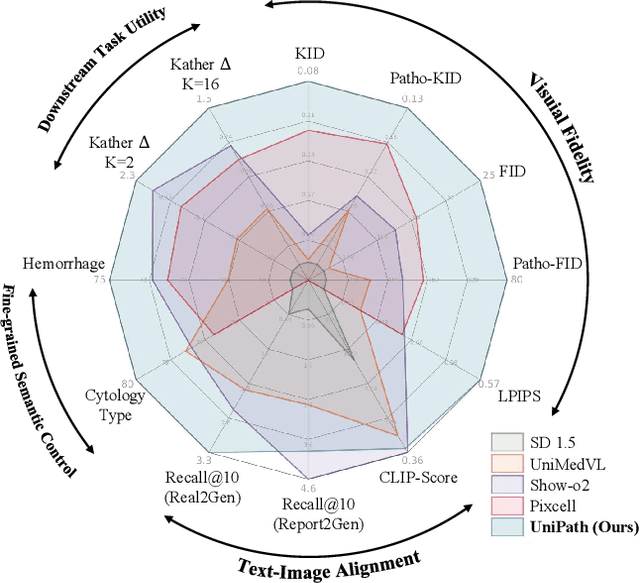
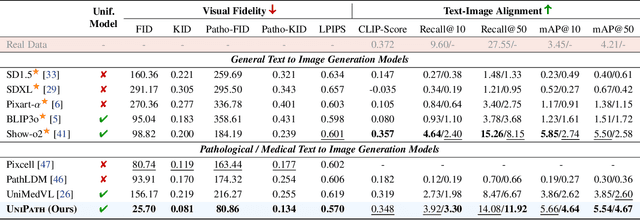
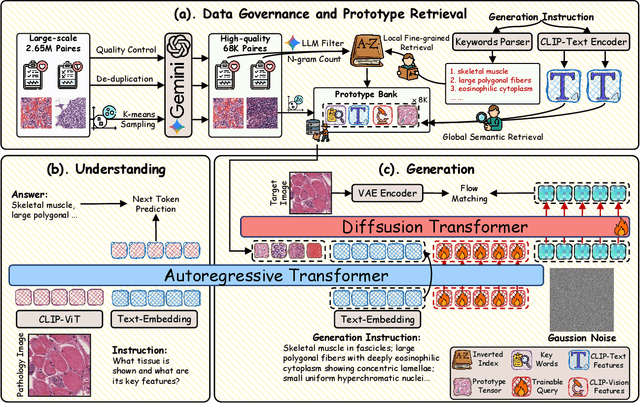
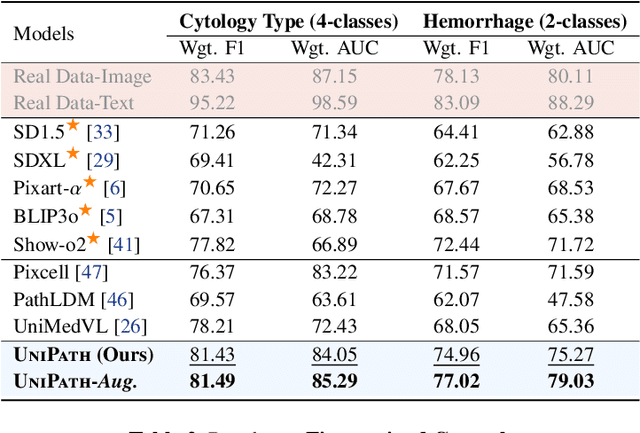
In computational pathology, understanding and generation have evolved along disparate paths: advanced understanding models already exhibit diagnostic-level competence, whereas generative models largely simulate pixels. Progress remains hindered by three coupled factors: the scarcity of large, high-quality image-text corpora; the lack of precise, fine-grained semantic control, which forces reliance on non-semantic cues; and terminological heterogeneity, where diverse phrasings for the same diagnostic concept impede reliable text conditioning. We introduce UniPath, a semantics-driven pathology image generation framework that leverages mature diagnostic understanding to enable controllable generation. UniPath implements Multi-Stream Control: a Raw-Text stream; a High-Level Semantics stream that uses learnable queries to a frozen pathology MLLM to distill paraphrase-robust Diagnostic Semantic Tokens and to expand prompts into diagnosis-aware attribute bundles; and a Prototype stream that affords component-level morphological control via a prototype bank. On the data front, we curate a 2.65M image-text corpus and a finely annotated, high-quality 68K subset to alleviate data scarcity. For a comprehensive assessment, we establish a four-tier evaluation hierarchy tailored to pathology. Extensive experiments demonstrate UniPath's SOTA performance, including a Patho-FID of 80.9 (51% better than the second-best) and fine-grained semantic control achieving 98.7% of the real-image. The meticulously curated datasets, complete source code, and pre-trained model weights developed in this study will be made openly accessible to the public.